|
Part Three
Who is really damaging the range?
One of the difficulties in figuring out the wild horse debate involves the amount of disinformation and spin that is involved. More extreme wild horse activists claim that all BLM wants to do is remove every wild horse from the range. The greedier and less honest members of the ranching community charge that the current populations of wild horses are destroying the range. As is often the case, neither extreme view is valid and the truth lies somewhere in between.
For example, the Virginia Range herd, managed by the Nevada Department of Agriculture (not BLM) is arguably the largest contiguous herd of wild horses left in North America. Bands of wild horses can be seen by the skilled observer all over Storey County and in parts of Washoe and Lyon counties as well as the outskirts of Carson City, the State Capitol. Less skilled observers, including tourists who travel Nevada to see wild horses, often don't notice these animals unless they are grazing right next to the highway as left to their own devices they leave little lasting signs on the landscape.
As stated earlier in this feature, each range is different and some ranges can't support around 1,400 free-roaming horses, however there is ample evidence that wild horses are not the source of range deterioration that some would have the public believe. Horse herds actually consist of numerous nomadic family units called bands. They wander along as they graze and leave most of the plant communities intact.
Similarly, not all public lands ranchers are ogres with respect to wild horses and the range. Many family ranchers recognize the need for proper stewardship of the land, respect the multiple use doctrine and the presence of wild horses, and some have invested considerable sums in developing water sources and other improvements that make the presence of horses and cows more compatible on the ranges that they lease. However the trend in conversion of ranches from family to corporate operations seems to have placed a greater interest on the financial bottom line and less of an interest on stewardship and respect for the multiple use doctrine.
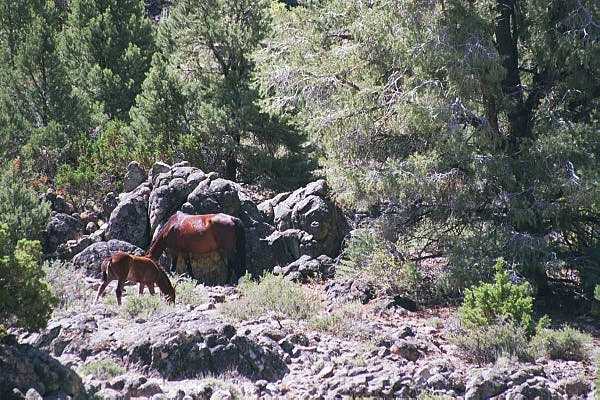
A mare and foal graze in the Virginia Highlands (NV)
When the Wild Free-Roaming Horses and Burros Act was passed, Congress declared in the law,"... that these horses and burros are fast disappearing from the American scene." It is alarming to some wild horse advocates that the current goal of the BLM is to reduce free-roaming herds to about one-third of the animals present when Congress made this declaration and it is their position that such drastic reductions are not compliant with Congress' expressed intent.
BLM's position has been that it needed flexibility to make decisions based on range conditions and other uses under the multiple use doctrine. BLM further argued that as a practical matter, free-roaming populations needed to be maintained at a level where the annual foal crop would not exceed the established rate by which gathered wild horses are adopted.
Wild horse groups have countered that it was Congress' intent that range animal maintenance levels (AMLs) for horses and burros be based on established range science, not the convenience of running an adoption program, and that many present day AMLs are arbitrary and genetically not viable.
Wild horse groups have further argued that the excessive costs incurred by BLM's Wild Horse and Burro Program are the direct result of what they consider to be excess gathers, too little emphasis on expanding humane adoptions, and a policy that resulted in thousands of horses being "boarded" in long term holding facilities.
BLM's counter argument was that the ballooning of holding facility inventory was a necessary product of a combination of reducing herds to manageable levels and a policy of turning many of the most desirable and successful horses back onto the range rather than strip the herds of their best and most adoptable specimens.
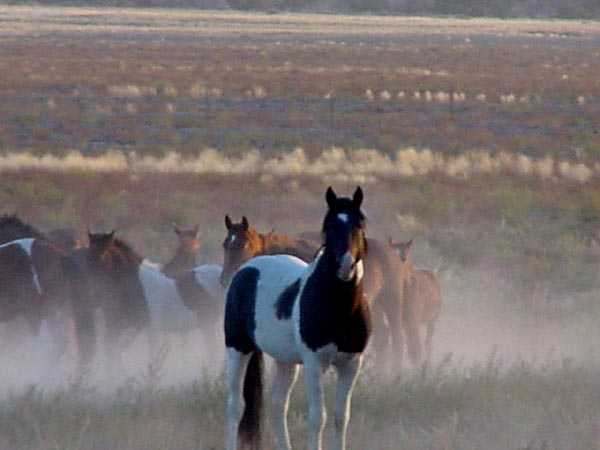
Wild horses on Utah's Onaqui Range
The most likely "reality" is that there are some livestock permitees who could be held up as examples of careless operators who contributed to overgrazing, there are some examples where BLM failed to get ahead of "runaway populations" in specific areas, and there are circumstances when one or more of the above combined with damaging natural and man-made phenomenon that resulted in bad range conditions.
There are also arguments being developed that the system of range management oversight has become so skewed by political intervention that it is no longer functional. (Please see the Audibon article,
Sacred Cows.)
This is not a BLM operated or BLM sponsored site.
It is run by private wild horse and burro enthusiasts.

| 