|
|
|
WILD HORSES ON THE RANGE
by Willis Lamm
|
Part Four
The adoption equation.
Putting aside all the arguments with respect to whether horses and burros should be gathered and if so, how many, the fact remains that certain numbers of these animals are being brought in from the range and they need somewhere to go. The most practical option is for excess
animals to be placed in qualified and caring private hands. As the Wild Horse and Burro Program evolved and BLM learned from its successes and mistakes, a viable adoption program now exists where adopters must meet minimum requirements for proper maintenance and care, these requirements are typically verified, and adopters will not receive titles to their animals until they have demonstrated at least one year of good care.
Congress passed legislation that allowed BLM to enforce these regulations and allowed the U.S. Attorney could prosecute adopters who wilfully or negligently violated the conditions specified in their Maintenance and Care Agreements. Legal accountability on the part of adopters significantly reduced abuses of the adoption program and at present around 98 percent of adopted animals successfully go to title.
The adoption program has also generated positive economic impacts. Horses and burros cost money to maintain, conservatively $1,000.00 per year on average. When adopters choose to spend their disposable incomes on maintaining adopted animals, in contrast, for example, to purchasing foreign made consumer products, virtually all of these expenditures stay in the region's agricultural economy. These expenditures benefit hay growers, farm employees, haulers, feed stores and their employees, veterinarians, farriers, etc. Also, since wild horses and burros are usually placed in a "niche" market, the economic benefits from such placements have no significant adverse impact on the pedigreed horse market. Therefore BLM's adoption program motivates people to invest in the agricultural sector.
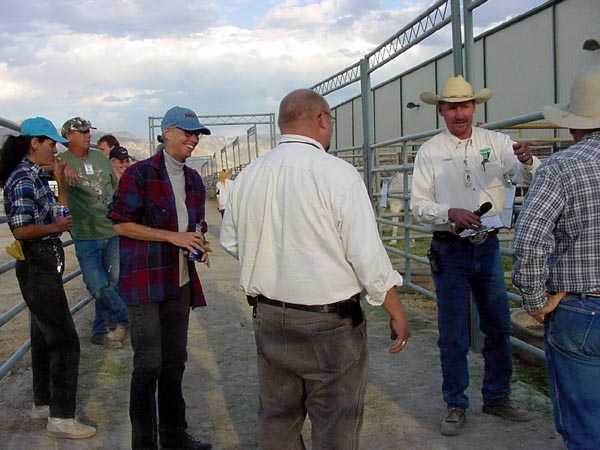
Adopters bidding on horses in Utah
One area that was traditionally difficult for BLM to address involved adopter education. While requiring a proper size corral, proper shelter, proper feed and water might meet the basic physical needs of a wild horse or burro, a more complicated issue involves adopters' abilities to desensitize, gentle and train their adopted animals. Adopters come in all levels of skill and experience, and some of that skill and experience may or may not be relevant to taming a truly wild animal.
Adopter education is an important element that relates to the degree of success that BLM's adoption program enjoys. Aside from the inherent benefit to the animal when an adopter understands his emotional as well as physical needs, adopters who had good experiences adopting their first animals have exhibited great "brand loyalty." An informal survey conducted in 2000 by wild horse mentors revealed that households reporting having "a very good experience" with their first adoptions, on average, adopted a total of 3.6 animals per household over a five year period.
As a result BLM has partnered with qualified non-profit horse groups to teach humane and effective gentling and training of wild horses and burros. In many of these programs, prospective adopters can gain supervised hands-on experience in the pens with clinicians with wild horses and burros and be well prepared when they take their wild ones home.
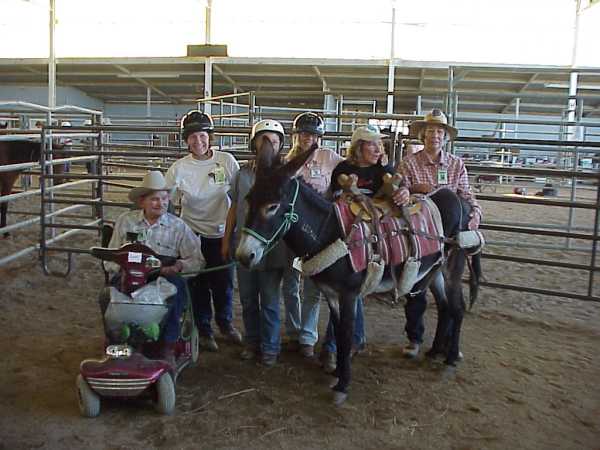
A burro well gentled by volunteers at Wild Horse Workshop 04.
The Wild Horse Workshops are joint ventures between BLM and
Least Resistance Training Concepts (LRTC).
It is difficult to quantify in economic terms the benefits of hands-on adopter education. One can correlate increased numbers of horses adopted and higher adoption bids when adoptions are associated with educational events. However adoption success involves a myriad of factors that may contribute to a good or poor results at a particular adoption. Nonetheless one can see the nexus between adopter education and animals going to better (more prepared) adopters, more animals getting adopted, and adopters who are more likely to return for more horses.
This is not a BLM operated or BLM sponsored site.
It is run by private wild horse and burro enthusiasts.

|
