|
|
|
WILD HORSES ON THE RANGE
by Willis Lamm
|
Part Two
Pros and cons of management decisions.
There are millions of acres of public rangelands spread over dozens of different climate and microclimate zones. Some of these ranges are in some of the most arid regions of the country. Others are subject to harsh winters and baking summers. Still others can be found in more temperate zones where the environment is less uncharitable.
The one "blanket consistency" that withstands scrutiny is that there is no single hard and fast rule with respect to how various activities impact range health. Some ranges can recover from wildfire or overgrazing in a season or two while other ranges still show signs of damage from early settlers. Using fire and grazing as simple examples, how "Range A" responds to these impacts may be completely different than how "Range B" responds. Therefore nobody can offer a one-size fits all strategy for maintaining healthy ranges.
There is one bit of rationale, however, to which all parties of the range discussion should agree. Healthy ranges equal healthy animals, whether those animals involve wildlife, domestic stock or free-roaming horses and burros. But this agreement breaks down in the nuts and bolts of who is causing what damage to the range and what should be done about it.
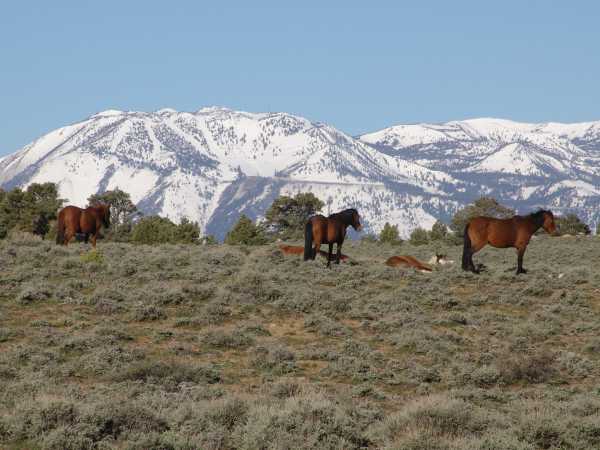
The "Cartwright Band" takes a late morning snooze in Storey County, NV
As established by the Taylor Grazing Act of 1934, livestock operators have the ability to contract for grazing leases on those public lands that are adjacent to their own properties. These leases allow for the placement of domestic animals to graze public lands during established grazing seasons. Permitees don't lease the land, just the grazable forage, so in theory these public lands are still accessible to other appropriate public uses, including the free-ranging of wild horses and burros as identified in the Wild Free-Roaming Horses and Burros Act.
The multiple use doctrine provides for the most fair access to and use of America's public lands, however leasing what basically constitutes consumable grass to commercial interests while establishing populations of non-domestic animals on those same ranges that similarly consume grass sets the stage for an obvious conflict.
The way the system is supposed to work is that the grazing capacity of each range is established using a measurement called an animal unit month (AUM). Note 1 The total available AUMs are estimated, then AUMs are subtracted for the grazing wildlife and wild horses that are present, and the remaining AUMs are made available to the grazing permittee for his or her livestock. The permittee then knows how many head of livestock can legally be put out to graze over the period of the lease.
It follows that the greater number of free-roaming horses or other grazing wildlife present, the fewer number of AUMs remain available to ranchers. The ranching interests point out instances where they argue that wild horse populations have grown "out of control," absorbing what they view to be excessive available AUMs and in some instances, spreading onto private lands in search of forage. The National Cattlemen's Beef Association and other grazing groups are constantly in pursuit of BLM to keep horse populations down, or remove them altogether.
The response from the wild horse advocacy camp includes arguments that public lands ranching costs American taxpayers around a half billion dollars annually in subsidies and other related costs, that traditional ranching families are being replaced with large corporate ranching operations, and that for all these costs, less than 3% of America's beef comes from public lands ranching.
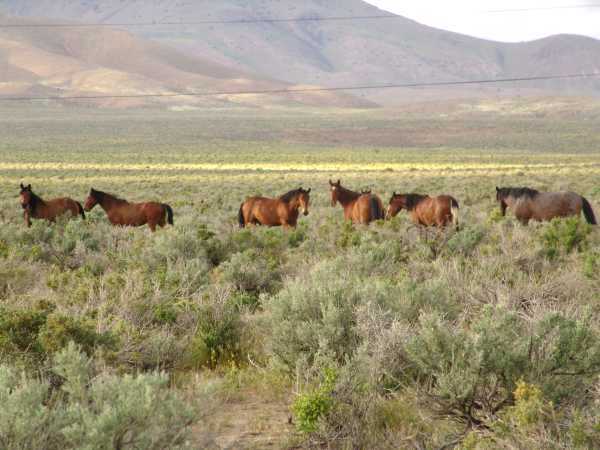
The "Stagecoach Seven." (The 7th horse is a baby behind the 3rd horse from the right.)
Notes:
- AUM refers to 800 Lbs. of dry forage - the grazing consumption in a typical month of a cow and its calf, one horse, one bison, five sheep, elk or mule deer, or six to seven goats or white tailed deer. (Different species of similar sizes may have different rates of metabolism and therefore different rates of consumption.)
This is not a BLM operated or BLM sponsored site.
It is run by private wild horse and burro enthusiasts.

|
