KBR Wild Horse and Burro Information Sheet

  WILD HORSES ON THE RANGE
by Willis Lamm

Horses evolved in North America. These ancient animals weren't just some sort of distant relative of the modern horse. They were of the same genome and some were large beasts, oftentimes 18 hands or taller. (See Carson man isn't looking ice-age gift horse in the mouth.) Therefore it doesn't take a great leap of reasoning to understand that as a reintroduced species, horses will be very successful if left to roam freely on North American ranges.

If ranges were left undeveloped, unfenced and unintruded upon by man, these free-roaming horse populations would return to their self regulating symbiotic relationship with the land. Mother nature would apply its age old formula of keeping everything in balance. Unfortunately the western range, as barren as it may appear, serves a host of interests and demands and such interests and demands affect wild horses. Furthermore, each "human" interest comes replete with human designed strategies and arguments to further such interests. Unfortunately the horses cannot speak for themselves.

Two bands of horses on Geiger Grade, overlooking Washoe Lake and Reno, NV.
Federal public lands management policy calls for the multiple use of public lands. Free-roaming horses are just one component of those multiple uses. Therefore the argument presented here is not that horses shouldn't be managed in accordance with this policy, but that this management should be different from what is currently practiced.

  • In 1971, Congress unanimously passed the Wild Free-Roaming Horses and Burros Act.

      § "Congress finds and declares that wild free-roaming horses and burros are living symbols of the historic and pioneer spirit of the West; that they contribute to the diversity of life forms within the Nation and enrich the lives of the American people; and that these horses and burros are fast disappearing from the American scene. It is the policy of Congress that wild free-roaming horses and burros shall be protected from capture, branding, harassment, or death; and to accomplish this they are to be considered in the area where presently found, as an integral part of the natural system of the public lands."

    Congress charged the Department of Interior and its Bureau of Land Management (BLM) with managing wild horses and burros.

  • In 1974 it was determined that approximately 60,000 horses and burros roamed federal public lands.

  • By 1975 BLM had removed and "warehoused" about 40,000 wild horses.

  • Today it is likely that there fewer than 36,000 free-roaming horses and burros remain on federal public lands.

  • BLM has stated an objective of bringing its free roaming herd populations down approximately 20,00 head.

  • BLM's removal policies have resulted in more animals coming into holding facilities than have been placed with adopters. As of February 13, 2006, BLM reported:

    • 3,596 animals in preparation facilities

    • 5,563 animals in holding facilities

    • 17,271 animals in long term holding facilities Note 1

    • 9,297 animals targeted for gathering during FY 2006

    • 3,697 animals gathered this winter (so far)

    • 1,388 animals adopted (FYTD) Note 2

    • 231 animals sold (FYTD)

Notes:

  1. Long term holding involves animals not expected to be placed with adopters.

  2. FYTD = Fiscal Year (commencing October 1) to date.
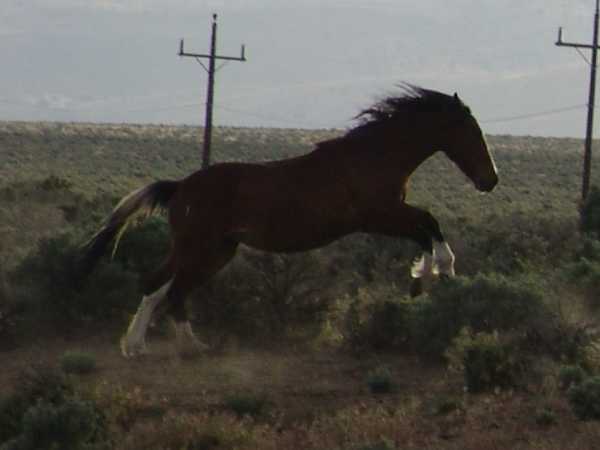
A Virginia Range mare playing on the open range in the Dayton Valley (NV)

Continue to Management Arguments, Pro and Con

This is not a BLM operated or BLM sponsored site. It is run by private wild horse and burro enthusiasts.

Return to Wild Horse & Burro News

Return to KBR World of Wild Horses & Burros

Go to other Wild Horse Links

Go To KBR Horse Net