Note: This document is a continuation of Part Four.
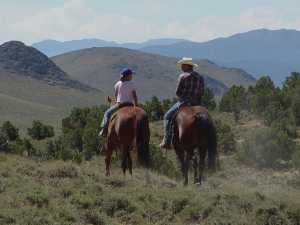
Knocking off as the day started getting warm.
Conclusions
Risks to animals can be reasonably managed during gather operations. While each gather environment is different, it is our conclusion that the following general guidelines contribute to a "safe and sane" gather.
- Understand what you're getting into. Assess the terrain, geography, horse habits and other factors so that the gather design is based on "real" factors.
- Select the gather strategy that best fits current environmental conditions.
- Make the best use of terrain, natural land forms and horse movement patterns to facilitate easier and safer movement of bands into trapsites. Multiple trapsites may often be more efficient than "herding" bands great distances, and shorter pushes to trapsites are safer and less stressful to the horses.
- Establish realistic expectations with respect to how, where and how many animals can be expected to be safely gathered as well as the time frame that gather objectives are expected to be completed.
- Establish a sensible gather "mind set." Gathers are not contests to see how many horses can be brought in. Gathers are expensive, somewhat complex and logistically extensive operations. Make practical use of available resources and preserve safety and application of common sense as the top priorities.
- Allow the pilot reasonable discretion in choosing which bands to bring in. You're not going to get all the horses anyway so pushing a band with a small foal a long distance, trying to trap aged or lame horses or attempting to move animals through extremely difficult terrain may not be in the best interests of the animals or the gather. The pilot needs to be allowed to move on and focus on a more appropriate band to bring in when he so chooses.
- Don't waste time and money gathering and shipping aged animals. They generally don't adapt as well to the domestic environment and they aren't much of a reproductive threat.
- Have outriders available to immediately respond to strays, especially foals, so that they can be brought in and reunited with their bands before they can totally disappear into the cover.
- Suspend gather operations when weather conditions increase the risks to the animals and personnel (e.g., when the day gets hot, thunderstorms are building up, etc.)
- Handle (sort, mark, load) horses in smaller groups whenever possible to minimize potential for shoving, trampling and fighting.
- Be capable of providing "special accommodations" for young foals and any "special needs" horses.
- Plan your work and work your plan. While adaptation may at times be necessary, everyone following a sensible plan, without competing "bosses" confusing the issue, contributes to a calmer and safer gather.
- Keep it simple. We observed this gather because of reported issues relating to a US Fish and Wildlife Service gather at Sheldon. Sheldon conducted a helicopter gather at the same time a horseback gather was taking place and it appears that the whole operation wasn't practical or well organized. The simplest approach is oftentimes the safest approach and there are fewer ways for things to go wrong. Tried and true basic approaches, adapted for the environment of a particular gather, typically can get desired results while minimizing the risks to animals and personnel.
It only makes sense that if bands can be kept intact until final sorting, and nursing mares are kept with their foals as much as possible, the animals will be less stressed, and be less likely to overreact to some unexpected stimulus and hurt themselves and/or other animals in the corrals.
It is quite evident that until other population control methods become more reliable, gathering of excess horses will be the primary approach to managing wild horse populations. We have seen that such operations can be conducted in a sensible and relatively safe manner, and we would wish that all agencies that manage wild horses would conduct gathers with the same professionalism and sensitivity as we observed at the Buck and Bald Complex.

|