Collecting Traffic Signals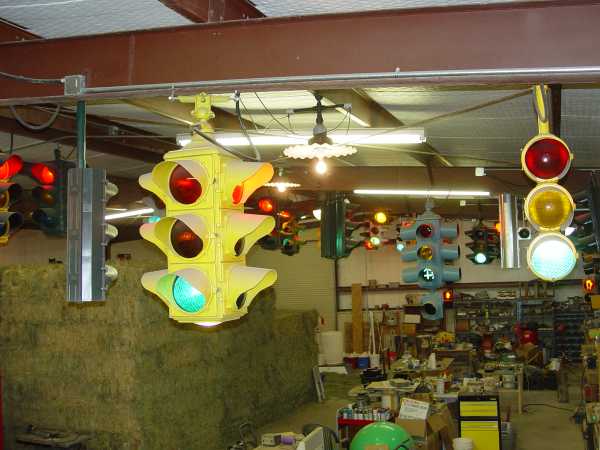
People collect almost anything and traffic signals are no exception. We may suffer from nostalgia for the days when traffic signals were more interesting and more diverse. We may like to restore things that light up. We may just be motivated to tackle an unusual hobby. But most signal collectors share a passion for those early icons of motor travel and love to put some discarded assemblage of glass and aluminum back into working order. The purpose of this feature is to provide a few tips for folks who are interested in starting a signal collection and would like to avoid repeating the mistakes that a number of us have already made. |
| BEFORE YOU START |
|
You need to consider a few basic logistic issues before starting a signal collection. First, signals can take up quite a bit of room. Most people want to display their work - indoors, in the back yard, in the garage or perhaps in a shop building. While it is not critical that you have dedicated space for completed signals before you start, it is often a good idea if one's wife / husband / parents are in agreement as to where these objects d'art are going to reside before you start moving out furniture or string wire between the back yard trees.
Some of the older signals may have a few coats of lead based paint. You'll want to find a safe area away from children and pets to strip off this material and paint the signals with modern non-leaded finishes before keeping them inside the house. If you plan to light up your collection you need to understand some basic wiring principles so that your display is "safe and sane" and doesn't pose an electrocution or fire hazard. These are all basic concepts discussed in this feature, not that difficult to deal with, but that need to be considered nonetheless. Also, from an accurate restoration standpoint it is helpful to know what features (lenses, reflectors, etc.) were authentic to a particular signal being restored so efforts spent acquiring missing parts actually result in getting the right parts for the project. Such information is available on the web and there are groups of signal collectors actively trading, selling and buying all sorts of parts, not to mention all the stuff available at on-line auction sites such as eBay. |
Click photos to bring up
|
| Please continue through this section if those of you who may be considering becoming serious traffic signal collectors would like to learn from my experiences (and mistakes!) |