|
In the first part we discussed the problems for both horses and habitat when the herds were not managed. Here we will discuss the evolution of modern horse management.
In order to properly manage the herds, the BLM first had to determine how many horses each populated area could support "in balance" with the other native wildlife and ecological needs. Several hundred "habitat management areas" (HMAs) were established and studied. This in of itself was a daunting task. From there, a process had to be developed to reduce the horse populations to the numbers which were established as being appropriate for each HMA. Nothing like this had ever been attempted before on such a large scale. The BLM tried a number of various methods, most of which had some form of negative outcome. It wasn't appropriate to "dispose" of excess horses. Relocating horses from fragile areas to new "managed horse preserves" turned out to be prohibitively expensive. Early birth control schemes seemed to have negative environmental and "natural selection" issues. The Adopt a Wild Horse or Burro program turned out to be the most effective population management tool.
Through a combination of stepped up enforcement efforts and use of citizen volunteers, compliance with the provisions of wild horse and burro adoption agreements has improved dramatically. Furthermore, through the courts, policy actions and legislative efforts, the original act which had few provisions for enforcement has been strengthened so that people who intentionally violate its provisions can be prosecuted. As a result, the slaughterhouse issue should have been put to rest. On September 10, 1995, Martha Mendoza published an article in the Houston Chronicle in which she reported that certain animal rights activists' allegations that BLM workers were deliberately diverting horses to slaughter and pocketing the proceeds. (Click here to read a copy of the article.) Although the charges were never substantiated, this report started an avalanche of protests and other news articles which included a whole litany of misconceptions and deceptions such as portraying horse slaughter problems which occurred before WHB enforcement was enacted as still occurring along with outright fabrications such as BLM WH&B Program Director Tom Pogacnik being quoted as saying "90% of the adopted horses (were going) to slaughter." These reports, of course, prompted a counter-protest by the thousands of adopters who have received and taken proper care of their wild horses and burros. The animosity and the furor only increased as subsequent news reports and articles based their stories in part on the errant "facts" of previous reports rather than on "hard facts." Something terrible was bound to happen and it did. Continue to Destroying What We Want to
Protect
This is not a BLM operated or BLM sponsored site.
It is run by private wild horse and burro enthusiasts. KBR Horse Net KBR Horse Net |
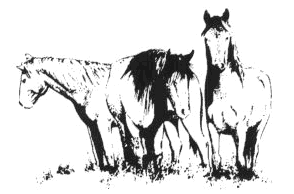
 The Wild Free-Roaming Horses and Burros Act protected and set
management standards
for wild horses and burros on lands under the authority and control of the
Bureau of Land
Management (BLM). This act by no means protected all of the North American
wild horses,
but it was a major step forward which protected most of them.
The Wild Free-Roaming Horses and Burros Act protected and set
management standards
for wild horses and burros on lands under the authority and control of the
Bureau of Land
Management (BLM). This act by no means protected all of the North American
wild horses,
but it was a major step forward which protected most of them.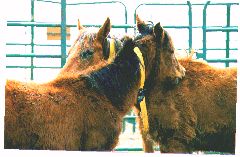 The BLM hoped that the significant public support for wild horses and
burros would
carry over to a demand for wild horses by private adopters. Many Americans
did adopt,
however there were more horses than adopters. The BLM permitted parties to
adopt by
"power of attorney." The idea here was that someone could represent a
humane
organization or private group to place horses in private reserves for
private management
and viewing. As with any new program, there were a few unscrupulous
parties who attempted to,
and for a while did, use the Adopt a Wild Horse or Burro program for their
own private gain.
Unfortunately, in violation of the Act, these scoundrels diverted a number
of adopted horses
to the slaughterhouses.
The BLM hoped that the significant public support for wild horses and
burros would
carry over to a demand for wild horses by private adopters. Many Americans
did adopt,
however there were more horses than adopters. The BLM permitted parties to
adopt by
"power of attorney." The idea here was that someone could represent a
humane
organization or private group to place horses in private reserves for
private management
and viewing. As with any new program, there were a few unscrupulous
parties who attempted to,
and for a while did, use the Adopt a Wild Horse or Burro program for their
own private gain.
Unfortunately, in violation of the Act, these scoundrels diverted a number
of adopted horses
to the slaughterhouses.