|
Note: This document is a continuation of Part One.
What We Observed
The pilot was not directed to bring in every horse that he saw. At Buck and Bald he was allowed reasonable discretion. If he were to spot a band with a very small foal, a really old or lame horse that couldn't keep up, etc., he could simply move on to a safer band to haze into the trap. Furthermore, outriders were present in the event any of the horses being gathered, particularly a foal, happened to break away from the band being brought in. The crew would make sure that the number of horses in the trap equaled the number of horses spotted when the helicopter first approached the band.
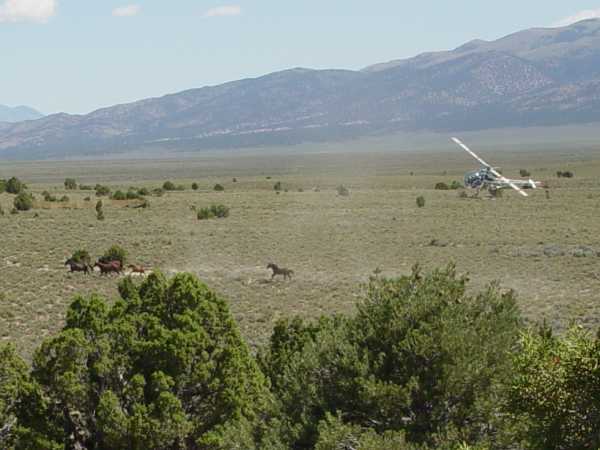
The helicopter was used primarily to "drift" the horses toward the trap. This mainly involved maintaining a position between the horses and juniper cover. Horses could move forward at their own speed so long as they were moving in the proper direction. (The pilot was experienced and could anticipate and flank the band being brought in if the horses started to break toward a wrong direction and he could correct their course before they broke into a dead run.)
The pilot maneuvers to discourage the band from cutting back into the trees.
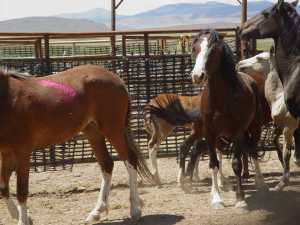
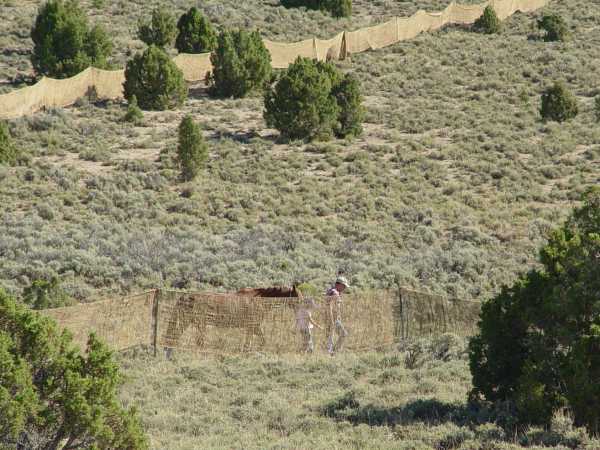
The traps utilized natural terrain so that the horses were more likely to move into the trap without spooking or crashing the burlap trap wings. Judas horses were used to encourage the horses to keep moving forward into the trap. Small numbers of horses were collected in the trap and moved down to the sorting pens in order to minimize shoving, crowding, fights and foals being hurt. Generally foals would be sorted into a side pen, transported in a separate trailer or compartment, and reunited with their dams a few minutes later at the sorting pens. Dams and foals were "painted" with identification markings in order to help prevent foals from being inadvertently separated from their dams once a part of a larger population.
Leading one of the Judas horses to the mouth of the trap as a band approaches.
Horses typically entered the corral at a trot or easy lope.
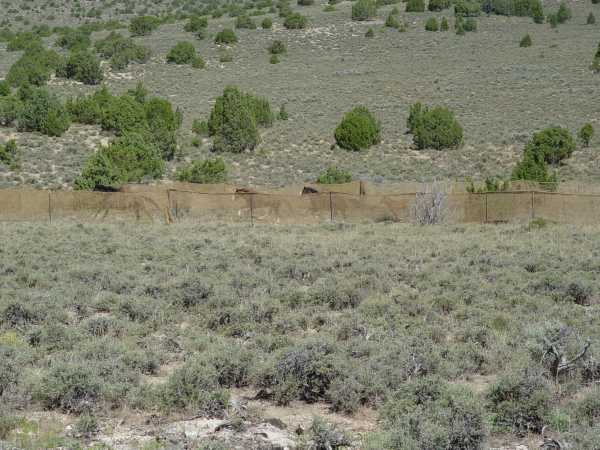
Foals were not left corralled with larger horses other than the nurse mares. A few nurse mares and their foals were put together in a pretty large corral where they could pair back up in an uncrowded environment. A separate corral was provided for any really young foals that might be more prone to being shoved or trampled where they could stand with their dams.
A couple of youngsters in the trap waiting for their dams to come through.
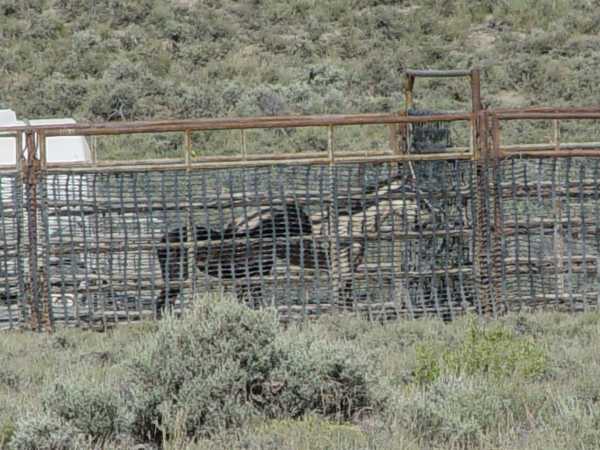
The sorting pens and chutes were designed to be efficient but be reasonably safe. The horses were moved in single file. Foals were directed into the nurse mare pen. Mares with milk were then let in to pair up with their foals. Yearlings were sorted into an adjacent pen so they would be still be close to their dams. Studs were on the opposite side of the pen from the nursing mares. "Dry" mares had their own pen. An extra pen for any really small foals and their dams was off by itself.
After resting for the night, being inventoried, and all the nursing mares checked to make sure that they were being suckled, the animals were loaded in transports headed to Palomino Valley. Studs and dry mares were loaded in one transport. Nursing mares were loaded into a second transport with their foals in an adjacent, but separate compartment. The yearlings were also transported in a compartment separate from the mature horses.
Helicopter gathering ceased as soon as the day got hot. On the date of our observation (July 10th) this occurred about 11:30 AM. While some other bands were visible from the air, it was determined that it would probably get too hot by the time the horses were moved over to the trap so they would be gathered at daybreak the following morning.

|