|
Important Note!
Some of these sequences were photographed decades ago before we participated in a helmet safety study. The results of the study were impressively conclusive. Since 1998 we always wear approved helmets when training and handling horses.
Some wild horses will allow a close approach after desensitizing
them using "approach and retreat" and learning that the various
movements that we make in the pen are not threatening. With these horses, we will approach them from the side at about the shoulder and maintain quiet and direct approach and retreat activities until we can touch their shoulders with a brush or hand.
With more volatile or fearful horses, we want more distance when
making "first contact." The bamboo pole allows the horse to be
touched and experience a comfortable grooming interaction with
with the handler while the handler remains a safe distance
away. This extra distance will usually reduce the horse's stress level and keeps the handler far enough away that the horse can't connect with a kick if he perceives the situation is becoming too threatening or intense.
Here we will illustrate using the pole in the context of our
total day's work with the horse. For more complete information
on poling, click Gentling with a Bamboo
Pole.
OBJECTIVE: Make contact with the horse and have him like it
|
When I use the bamboo pole, I want the horse to remain curious
about the pole. If he stays curious he isn't likely to panic
when touched and is more likely to figure out that being rubbed
with the pole feels good.
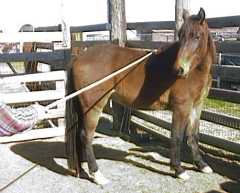
When the horse is in a relaxed state, I'll stand pretty much
even with the shoulder and touch the pole down on his withers
for a split second, then withdraw it so he can see it. This
contact may surprise, but should not panic the horse.
|
Starting at the withers
| |
If the horse walks out I will usually "follow" him with the pole, keeping my body relaxed, staying in a more neutral place in the circle and holding the pole over the horse. When he stops I'll trace him again, let him check the pole out if he wishes, then set things up to touch him again.
After the horse no longer flinches on contact, I'll rub the pole on the horse's back using a sawing motion. At first the pole will move across his spine, the rings on the pole providing the scratching sensation. Later I will "groom" the horse on parts of his body that face me by carefully rubbing the end of the pole around on his hide using short strokes.
On every horse there are one or more good spots where he is really comfortable being scratched. As I explore around on the horse and I sense his anxiety building, I'll go back to the closest "safe zone" and rub for about five seconds, then work my way back over to the scary new place.
| |
Once the horse is desensitized across his back and around his withers, I will stroke the horse, starting with short strokes, then gradually increasing them until I can rub him to his rump. Then I will look for itchy places to rub back there and start down his back legs.
Don't be surprised if your horse kicks at the pole. The real art to this part of the poling process is to read the horse and lift the pole before he takes a swipe at it. (We don't want to teach him to use his hind feet to get his way!) As soon as the horse appears anxious or shifts his weight, I'll move back to a safe area and then work back down to the "new" territory.
If done correctly, the horse may still lift a hind leg to say, "I don't really like this." I just reply with my body language, "That's OK, horse, I understand," and I go back and work on the closest safe zone for a few seconds, then limit my work down his leg to doses that he can tolerate. If it takes me several minutes to get him tolerant of having his leg rubbed all the way to the hoof, it's no big deal.
Please remember that each horse will require a different length of time to desensitize to various stimuli and approaches. Also a horse may appear completely comfortable with having one portion of his body approached and/or touched, yet be extremely reactive about other portions. Always read the horse during these activities.
|
Working back to the rump

Going down the rear legs

|
|
Next I'll go back to the withers for a few seconds of "pole reassurance," then I'll work on the chest.
It's important for the horse to remain curious about the pole and see what's going on so he doesn't panic and strike at the pole when it touches him. If this process is working correctly, he should be somewhat mesmerized at this point, so chest
contact shouldn't be that great of a deal.
Again, I'll start with brief touches and reassure the horse that this whole process is OK for him. Then I'll try to find places that he really likes to be groomed.
Once he's good with contact on his chest, I'll go down each front leg, starting with short strokes, and eventually gently stroking him from neck to toe. After that I will work around his neck, rubbing underneath as well as along the sides. Since there are crevices in the neck forward of the shoulder, I will maintain a "loose feel" on the pole so I won't accidentally poke him if he swings his head towards me and catches the pole tip in a "wrinkle."
|
Going down the chest

Down the front leg

|
|
The belly can be a touchy spot for many horses, but also often includes the itchiest, hardest to get places on his body. So while it may take a little finesse to make contact, the horse will probably really enjoy it once he's accepted it.
After spending a few seconds back at a "safe zone" near the withers, I'll make first contact under the horse a few inches behind the front legs. This location is critical. Too far forward and I might bump his front leg and send him off.
Too far back and he will probably reflexively cow kick the pole.
Since flies often congregate on the horse's belly, I need to make sure that I use a fair amount of pressure when rubbing the belly. As soon as the horse isn't "goosey," I'll apply plenty of pressure so the sensation he feels is one of relief,
not the feeling that more flies are landing on him.
As with every other point of contact, I remove the pole from scary spots before the horse walks off and I locate a nearby "safe zone" that I can "retreat" to with the pole without stopping contact in the event the horse starts to get anxious.
|
Real pressure
(Note the bend in the pole)

Crouching to get a better angle

| |
Some horses have a tough time having the backs of their front legs touched. I may be able to go straight to the leg from the belly, or I may need to have the horse pay attention to the pole and visually follow what it is that I am doing. The horse will dictate the approach I need to use.
As with the other legs, I'll still start with short strokes,
stroking the full length of the leg only after the horse accepts initial contact there.
|
Back of the front legs

| |
Once the horse is comfortable being rubbed all over with the pole, it's time to move to the next phase. In Part Four of this feature we will discuss getting a brush and hands on the horse.
|
Press "Back" to return to the page which brought you here
KBR Horse Training Information, © 1997 Lamm's Kickin' Back
Ranch and Willis & Sharon Lamm. All rights reserved. Duplication of any of this material for
commercial use is prohibited without express written permission. This prohibition is
not intended to extend to personal non-commercial use, including sharing with others for
safety and learning purposes, provided this copyright notice is attached.
Email us to submit comments or request reproduction
permission.
|


