Trailering Made Easy |
|

|
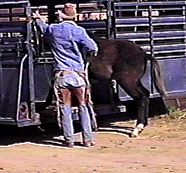
Original posting: 07/92 Revised: 7/17/13 The idea of loading a horse in a trailer is troublesome to many humans, as it is also no doubt troublesome to many horses. In such cases, the prospect of teaching a horse to load properly in a trailer can be downright terrifying! In reality, teaching a horse to trailer is not that big of a challenge. It can be done safely and painlessly. Of course a horse that has been previously "trailer raped" (forced into the trailer through pain and pressure) may take more patience, but the same fundamental principles apply. In this section we will take the mystery out of trailer loading. We will load in a trailer using both a ramp and a step-up configuration. The primary subject is "Stormy," a colt that is just about 6 months old. This will be his his first attempt at getting into this particular trailer and his first time being trailered without his mom being inside. Please note! There are many aspects to trailer loading and different horses have different issues with respect to trailers. In this presentation we'll take the mystery out of trailer loading but please review all the material before attempting to load a green or troublesome horse. Use common sense and apply those approaches that make the most sense in your particular situation!
On either side of the trailer there is plenty of room to work. I have prepared Stormy for this exercise by longeing him on a 12 ft. lead line for a couple of days. This longe work was done some distance away from the trailer. A key point here is that the longeing was not designed to cause the horse to travel in mindless circles, but develop a pattern of responding to directed energy and responding to a soft feel on the line. The horse should learn to longe both directions and reverse on the line and make other changes in direction without getting confused. This ability is of utmost importance for this particular trailering lesson. Ground poles can be added to encourage the horse to remember to pay attention to his feet.
|
| PUTTING THEORY INTO PRACTICE |
|
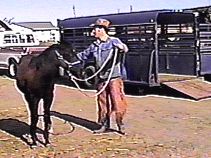
We started out the actual loading session by doing some basic longe work in the proximity of the trailer, but not so close to it that it affected our work. We did not run in mindless circles, but conducted a good longe line workout. The intent here was not to "wear down" the horse, but rather to get
him into "learning mode" using an activity which is both familiar to him and that will facilitate getting him to load. (For effective longe position tips, see Round Corral Logic.)
|
| |
|
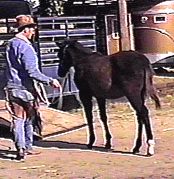
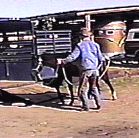
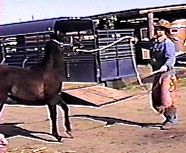
In this next photo we have let Stormy investigate the trailer. We set this up by longing near the left rear corner of the trailer and letting our energy go slack just as Stormy was trotting directly toward the ramp. This takes a little practice to get right. If Stormy passed passed up the ramp or ducked off the other way, no problem. We'd just go with it and keep him working. Eventually he figured out that the trailer is a pretty cool place to stop and rest.
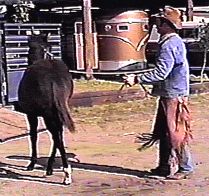
After a brief, relaxing sniff of the ramp, we sent him forward. We didn't expect him to just go straight into the trailer (which he didn't), and so we were prepared to continue longeing. Now that Stormy has approached the trailer, it's time for us to narrow down the choices. By changing my body position, he almost has to come up to the ramp. If he stops at the ramp, he can rest. If he goes past it, or steps away from it when I twirl the rope and send him forward, we simply resume the longe lesson. Each time he stops, I want him to move just a little bit more forward before I let off the pressure. In each case, he can decide whether to advance slightly more up the ramp before he stops or to continue longeing. Key Point: To effectively learn the horse has to make the correct choice. Our job is to create a scenario where he is likely to make the correct choice. Most horses will duck away from the trailer as an avoidance so it's no problem to send them out to longe until they discover that leaving the trailer means work. Others may figure out that it's easier to crowd you and stall out. In these cases you will need to send the horse off. The handler must take care that the end product of this "send-off" isn't the horse longeing the handler (the handler moving his/her feet more than the horse moves its feet.) We wave the horse off with our hands and then continue the stepping away process by shaking the rope and walking toward him, or twirling the rope end toward his nose, or both. We have changed to a completely different lesson now. We want to teach the horse to move off when we ask and reward good movement by inviting him back in for some nice rubs and scratches. Pressure-reward, pressure-reward. Crowding the handler produces negative reinforcement. Returning to a proper position produces positive reinforcement. Pretty soon he has the picture and we can send him out on the longe without a struggle. Key point: Teaching the horse not to crowd the handler is a critical element in trailer loading. A horse that doesn't want to load is going to look for escape routes on either side of the trailer. As a practical matter we tend to work from the opposite side of the rear trailer door, therefore the horse sees its opening just past its handler. Handlers get knocked down because horses haven't been taught not to crowd them. Therefore teaching a horse to properly load involves a number of safe behavior elements that apply in a variety of circumstances.
Continue to: "Loading Up!" |
|
Press Back to return to the page which brought you here
Return to KBR Training Section
Return to KBR World of Wild Horses & Burros
Go to other Wild Horse Links
Go To  KBR Horse Net
|
KBR Horse Training Information, © 1992, 1997, 2013 Lamm's Kickin' Back Ranch and Willis & Sharon Lamm. All rights reserved. Duplication of any of this material for
commercial use is prohibited without express written permission. This prohibition is not intended to extend to personal non-commercial use, including sharing with others for
safety and learning purposes, provided this copyright notice is attached. Email us to submit comments or request reproduction permission. |